13 November 2011

Swakopmund, Namibia


I recently returned from a vacation with nine of my closest friends to Swakopmund, Namibia, a quaint tourist town on the coast of the Atlantic OceanNamibia was colonized by Germany, and the German influence is still present in the architecture, cuisine, and general way of life.

Wide boulevards


Not a great picture, but in the background
you can see the desert meeting the ocean
Mural wall

My favorite mural
It was a long trip consisting of buses and rental cars, but it proved to be worth it.  We rented two houses at Swakopmund Municipal Rest Camp, which came with an outdoor braai (barbecue) and an ocean view. 

Rental cars

House we rented

Ocean view from our porch

The main thing we did was eat delicious food.  Every morning I started my day with a large coffee and delicious German pastries at Raith’s CafĂ© and Gellateria.

Gellateria and Cafe

We found a little pizzeria that made thin-crust pizza and ended up eating there twice.


For our first nice dinner, we made reservations at a restaurant called Brauhaus, which serves authentic German cuisine.  It was my first time trying German food and I loved it!  It was a meal fit for kings and I was so full I could barely walk out of the restaurant.

Ladies dressed up for dinner


The girls took one afternoon and went off shopping.  There were a lot of cute boutiques to look through.  I found one jewelry and craft store in particular that I loved, and I picked out several necklaces and rings I wanted to buy for friends back home.  My plan was to return to the shop on Saturday and use whatever Namibian dollars I had left to buy souvenirs.  Imagine my surprise when I get to the store at 2:30 PM and everything is closed!  Apparently all stores in Swakopmund close at 1:00 PM on the weekends – except for grocery stores and bars/restaurants.  I wish I had known that before it was too late.

Of course, we went swimming in the Atlantic Ocean.  The water was very cold, but since I grew up on Lake Ontario it didn’t seem that bad to me.  What can I say about the ocean?  It's amazing.  I would be a mermaid and live in the ocean if that was an option.


We also got to watch the sun set over the Atlantic, which was very beautiful.  We went to Tiger Reef Bar, right on the beach, for sundowners.

Balcony view of the sunset

My friends Lindsey, Jen, and Nicole
Heidi and me
Heidi and me playing in the ocean one last time


Out on the jetty (or pier) there is a sushi restaurant called Jetty 1901.  There are glass panels in the floor so it looks as if you’re standing on the ocean.  We all went to sushi “happy hour,” where one roll cost only 20 Namibian dollars (less than 3 USD).  Before this, I had only eaten vegetable sushi, but at happy hour I tried different tuna and salmon rolls.  Turns out, my favorite was a salmon roll that also had fish eggs on it.  Sounds gross, but it was actually delicious!

Restaurant on the end of the jetty
Walkway to the restaurant


I'm the one with hot pink toenails, duh.
Another great meal we had was braai-ing (or barbecuing) fresh fish from the local fish market.  The boys bought the fish already gutted and salted, then wrapped it in tin foil with butter, garlic, and lemon.  We put it on the grill for awhile and voila! the most delicious fish I have ever eaten.  It was so good (and we had so much) that for dinner the next night we made fish tacos.

Fish on the braai
Always date a man who can cook

Waiting for dinner

YUM

To appease the daredevil in all of us, the whole group went quad biking in the desert, but that will be a blog post of its own.

All in all it was a wonderful trip.  When I got back to work, everyone complimented me on how happy and refreshed I looked, and it’s true.  An ocean-side getaway is exactly what the doctor ordered.

Being silly


A wave took us by surprise!

Taking a shopping break to meet up for drinks


The closest we got to a "nice" picture of all the guys

See how happy the ocean makes me

11 November 2011

Condom Demonstrations

My big project for this last term has been doing condom demonstrations in all of the classrooms.  I luckily got in touch with a woman who works with the District Health Team in Molepolole (my district’s main village) and she hooked me up with a model penis, model vagina, and male and female condoms to use in the demonstrations.

Once I had the supplies, I got right to work.  There are seventeen classes at my school (meaning close to 700 students) and I needed at least two periods with each class.  Due to other projects I was working on, it wasn’t as simple as just going to all the guidance classes.  I had to figure out when I would be at school and when I would make up any classes I missed, as well as working around different examinations given by the school.  Also, the schedule has up to three guidance classes during the same period, despite the fact that we have only one guidance teacher.  Go figure.

For the male condom, my counterpart and I made signs with each of the steps to using a condom on them.  One side had English, and one had Setswana.  I was adamant about teaching this in Setswana, because incorrect condom use is a common occurrence.  We would have eight students come up and give them the signs randomly, and they had to work together to put the signs in the correct order.  I definitely have not reached fluency, but I think now knowing how to explain condom use ka Setswana is a good start.

After initially learning the steps, I would go over them again while demonstrating using a condom and the model penis.  (I taught over a constant stream of giggles – mostly from the boys, ironically enough.)  I would then have one boy and one girl demonstrate, although if no one volunteered, I didn’t push it.  It was really important to me to create a safe, comfortable environment so kids will stop being so scared to talk about sex and ask those really important questions.

And boy, do the kids have questions.  It was wonderful to see them opening up to me, and to know that I was helping to dispel some common myths.  Some things the students believe I expected to hear – condoms aren’t reliable, real men don’t use condoms, if you use a condom you won’t feel anything.  But other myths are truly astounding – condoms have worms in them that make you sick, the U.S. sends over condoms with HIV in it to try to wipe out African races, if you have sex with a girl on her period her vagina will bite you.

The following class I demonstrated how to use the female condom, which also got plenty of laughs.  Although I don’t believe many women use the female condom, there is a lot of interest in it, which is great.  I didn’t have enough female condoms for any students to also try, so after demonstrating and having a Q&A session we discussed different forms of birth control.

Most students had heard of the condoms, the pill, IUD, and injections (and, of course, abstinence).  Interestingly, almost every class also offered sterilization as a method of birth control.  While that’s true, I thought it was strange that students so young would have sterilization on the forefront of their minds.

We then reviewed bad forms of birth control, many of which the students believe to be effective:
  • “Pulling out,” or withdrawing before ejaculation
  • Having sex during the woman’s menstruation cycle
  • “Safe period,” which means having sex during the five days after a woman menstruates.  They believe that since the woman is not ovulating, there is a zero percent chance of her getting pregnant, and this is taught in science classes.  I emphasized that while it is not likely, it is still a possibility, and condoms/birth control should still be used.
  • Sex positions – i.e. if a woman is on top, gravity will keep the sperm from reaching the egg
  • Different methods from traditional doctors

It was encouraging to see how engaged some of the students were.  It made me feel as if I actually was making a difference in their lives, and that being informed will help at least a few students make better choices.  After a year and a half of ambiguous reporting to Peace Corps, it’s a great feeling to know I have solid numbers (I’ve reached 680 youth this quarter!) to send to Washington, D.C.

More than just helping the students, it was a small epiphany for myself.  I loved doing these classes, and I’m already in the process of putting together sex education curriculum for next year.  After feeling somewhat irrelevant for a lot of my service, I’m getting excited again, and perhaps my interest and passion can guide my career choices when I get home in June.

23 September 2011

Afrika Borwa


Or, A real city and my first steps in the Indian Ocean

A few months ago Daniel and I went on vacation to South Africa.  We took a bus to Johannesburg and stayed in a cool neighborhood called Melville.  The guesthouse we chose was called Sleepy Gecko and it was amazing: plush beds, wide-plank hardwood floors, original artwork, and a roly-poly guard dog who wasn’t fooling anybody.  Within a half hour of getting our room I had taken a hot bubble bath and donned the complimentary terrycloth robe.  The owners even invited Daniel and me to share dinner and a bottle of wine (or two or three or seven) while watching a rugby game.

It was amazing to be back in a city again.  Boutiques (including Black Coffee), restaurants, coffee shops, antique stores, even a farmer’s market… I was in heaven.  If unemployment wasn’t so rampant in South Africa, I would consider trying to find a job there.  While I’m sure Melville is the exception rather than the norm in Jozzie (there are a lot of rough areas in the city), I absolutely loved it and got a great first impression of Afrika Borwa (South Africa).

The most interesting thing Daniel and I did while we were there (wait, you mean besides sushi and half-off cocktails?!) was go to the Apartheid Museum.  It’s one of the best museums I’ve ever been to.  It walked you through all the aspects of apartheid – the social, political, and economic factors leading up to it, the oppression during it, and the growth and eventual victory of the opposition – through a variety of media.  We were luckily at the museum while there was an exhibit on Nelson Mandela.  Until then, I hadn’t realized how much I took for granted that he is just one of those inspirational people like Gandhi, and never took the time to research what his life was like.  I highly recommend visiting the museum (although, oddly and a bit off-putting, there’s a theme park not even a stone’s throw away).


I can’t post any pictures from Jo’burg because Daniel and I were too busy having fun to worry about our cameras.  True story.

Driving on the left side of the road!
We then rented a car and drove to Durban, where I accomplished a lifelong goal of seeing and swimming in the Indian Ocean, which is warm year-round.  Our time there passed in a haze of craft markets, beaches, gluttonous and embarrassing amounts of seafood (omg delish), blue skies, sunrises, copious amounts of wine and yes, long romantic walks along the beach (“romantic” is debatable – Daniel was more interested in shells and their inhabitants than me).

I am not kidding you when I use adjectives like “gluttonous” and “copious.”  We went to f-ing town on seafood.  Consequently, I went 200 USD over budget.  Ouch.  Moving on…

Daniel and I stayed at a place called Anstey’s Beach Backpackers right on the coast.  We got upgraded (holla) to a cottage with a full ocean view.  It was a beautiful little flat with a nice-sized porch facing the ocean.  It was even decorated in blues and whites – perfect for a beach house.


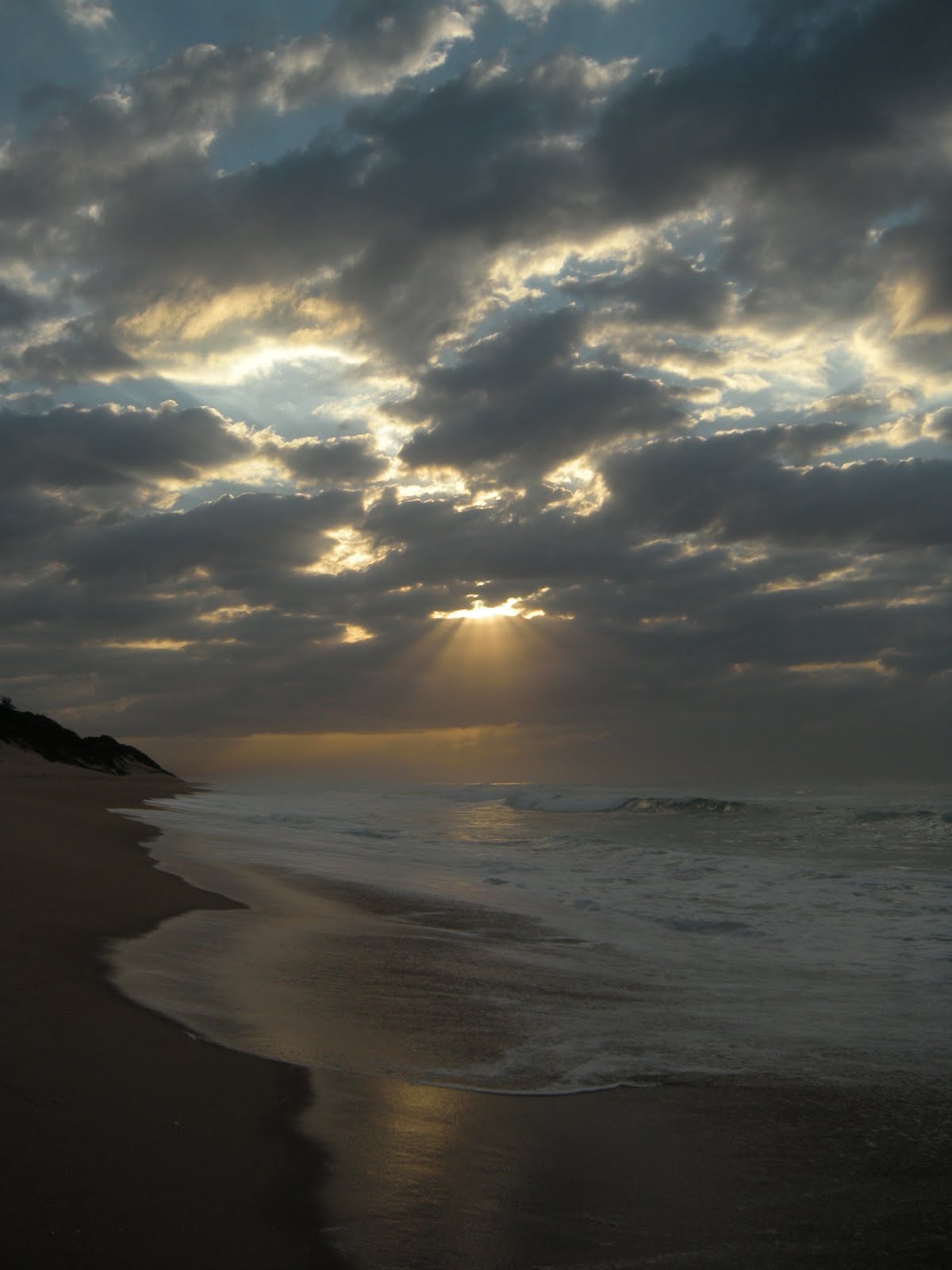
We woke up at sunrise every. single. day.  The entire trip.  Sometimes it was to get an early start on the road, but mostly I just couldn’t bear to miss a single ray of light coming over the ocean’s horizon.  Accordingly, I don’t think we ever stayed awake past 9pm.  Anyway, here are pictures of the sunrise over the Indian Ocean and some other beach pictures.

Early, early morning; view from our porch.  Have you ever seen such a gorgeous shade of blue?


Cloudy sunrise


Boyfriend!

My first steps in the INDIAN OCEAN!


Daniel's first steps in the INDIAN OCEAN!


Unfortunately I don’t have any photos of the different markets we went to or any of the cute outfits I wore (I spent a lot of time researching South African fashion before we went).  Just take my word for it.

It was a great trip, and a lovely getaway.  Here are a few last pictures:

A little restaurant we stopped at with a gorgeous view of a lake

Same restaurant

I came home to a SCORPION in my house.  Sweet.
Shout out to SHU!:


22 September 2011

Project AIM


This past week I have had the absolute pleasure of working with BOTUSA (a partnership between Botswana and the CDC) on a new project – Project AIM.  AIM stands for “Adult Identity Mentoring” and the six-week-long program is designed to help students connect with their future selves, thereby making them less likely to engage in risky behavior that will jeopardize that future.

Due to the wonderful success Project AIM has had in the states (participating schools had overall better grades, less truancy, and less unsafe sex), BOTUSA is now bringing it to Botswana.  This is where my help was enlisted – my junior secondary school was chosen as one of three to do a preliminary pilot of the program, as well as various focus groups.  This is to ensure that the program is appropriately adapted for youth in Botswana.  It was my job to organize groups of people for the facilitators to work with.

It was wonderful to work with Sarah (from CDC) and Catherine (from BOTUSA) as they implemented their activities.  They taught two lessons during which they engaged students in discussion about the idea of a legacy – that what we do in our lives now affects those that come after us.  They met with my YES Club every day after school to do a whole career series – including a personality quiz to find what career might be best, making business cards, and designing a dream house.  They conducted focus groups with form 1 students and parents, as well as interviews with teachers and community leaders.

Sound like a lot of work for four days?  It absolutely was.  (…I say that on their behalf.  I mostly just watched.)  But more importantly, it was interesting to see all the effort it takes to start such a program as this, and inspiring to meet people who are so dedicated to making children’s futures brighter.

You can learn more about Project AIM by clicking here.  I heard a bit about some really interesting versions of the program being conducted in the states – focusing on unique populations such as teenage mothers and transgender youth.  From what I saw this past week, it’s truly a program worth believing in.

28 August 2011

Life Skills Infusion Workshop in Malwelwe

The Botswana Ministry of Education has created a curriculum of basic life skills (which is where my title of Life Skills Volunteer comes from), and has additionally linked each topic to the HIV epidemic.  A “life skill” could be anything from self-awareness, to decision making, to risk taking, to healthy living.  It’s basically, um, a skill you use in your… life.  Life skills.  Yeah.

The curriculum is used by guidance teachers in all the schools.  The Ministry of Education also aims for every teacher to use the curriculum in their own classes.  Taking an objective from the Life Skills curriculum and using it in conjunction with an objective from a teacher’s own curriculum is called “infusion.” 

Unfortunately, the Ministry of Education never actually trained teachers on infusion.  Instead, they just gave out the Life Skills textbooks and said, “Have fun.”  Since infusion is not second nature and gets increasingly more difficult as students get older, this resulted in no teachers infusing.  Ever.

Two volunteers who were a year ahead of me (meaning their service finished in June) invited my best friend Paco and I to participate in an Infusion Workshop they were holding in a village called Malwelwe (yeah, just try to pronounce that name, I dare you).  The idea was that Paco and I would learn how to run the workshop and bring it back to our region, thereby training even more teachers on how to infuse.

The workshop in Malwelwe was fantastic.  First of all, we stayed with a teacher whose nickname was Chucks – I mean, you just know a woman called Chucks is going to be awesome.  The hospitality, generosity, and fun nature of the teachers at Malwelwe Primary just blew me away.

Additionally, these teachers were really into learning about infusion – how to do it, when it’s appropriate, and tips and tricks for infusing more difficult topics like science and agriculture.  With all of our presentations the teachers were engaged and attentive, and they seemed truly appreciative that we were trying to help their school.

I gave a session introducing how to plan an infused lesson

After a morning of introducing Life Skills and infusion, we had an afternoon of lesson planning.  The four of us Peace Corps volunteers went around the room, working with each teacher individually as he or she planned an infused lesson.  The teachers couldn’t just pick any topic, however – we had them plan a lesson that they were going to do with their class the very next day.  Having the hands-on session of lesson planning helped tie in all the presentations from the morning, and the teachers really seemed to pick up the goals behind infusion.


KG, Lucas, and John, who set up the workshop


Assisted lesson planning

The drive behind the entire Life Skills program is the HIV epidemic and, more generally, sexual health.  Sexuality is not exactly an easy thing to talk about in the classroom, especially for the first time.  We played a game with the teachers to lighten the mood as well as to get them comfortable with talking about different aspects of sex.  The game is called Abstinence or Not.  The teachers had to decide whether partaking in certain intimate activities (kissing, holding hands, etc.) was abstaining or not.  The game really gets people thinking about what abstinence actually means.  I think the funniest part was when we called out “mutual masturbation.”  One teacher turned to me and said, “Wait, what does that mean?  Who is touching who?!”  It was a fun way to  make sure the health/HIV objectives of Peace Corps Botswana were addressed during the workshop.


Explaining the rules of the game

Fun with abstinence

The next day, the four of us volunteers split up and observed the teachers during their infused lesson, and then gave the teachers feedback.  There were some teachers that were still struggling with the concept, but overall we mostly had positive things to say.  Here are some great examples of infused lessons: agriculture and goal setting; Setswana and communication; mathematics and decision making.
                                                                                                  
What made this 2-day workshop a success was truly the open-mindedness and willingness of the teachers to learn.  Paco and I are looking forward not only to bringing this workshop to other schools, but to a follow-up visit to Malwelwe!


21 August 2011

Chibuku


One of the benefits of living abroad is trying new things.  Botswana happens to have a traditional beer called chibuku. 

I love that it comes in a milk carton.  "Bojalwa jwa rona" means "our beer."

While I don’t know the particulars, it is made from maize and sorghum that has been allowed to ferment.  This results in a uniquely flavored, surprisingly filling alcoholic beverage that I liken to grainy, slightly chunky drinkable yoghurt.
  
See the grainy goodness

I wouldn’t say I’m a huge chibuku fan, but one time Daniel, a fellow volunteer, showed me the ropes of drinking it.  It’s actually quite a process.  The beer’s nickname is “shake shake” because you must shake the box before drinking it.  So, you press your thumb over a valve that is cut into the top of the box (you can see it in the above picture) and press down on the top to prevent leaking, turn the box upside down, and shake for at least 30 seconds.  The box starts to expand as the beer gets nice and foamy.  At this point you turn the box right-side-up and let go of the valve.  You open the box and voila! – chibuku.

Daniel secretly took a video of me while shaking the box (sorry, you have to watch it sideways):


Trying to shake without getting it on my clothes

Post-shaking foam


The first fateful sip
It's chunky!
Daniel is a fan

At 5 Pula a box, many poor people will forgo buying food for themselves and instead fill up by drinking chibuku all day.  Chibuku is sold at family-owned outdoor bars called shebins.  A shebin (she-bean) is typically someone’s house, and people will buy chibuku and then sit on benches in the yard while drinking and socializing.  It’s fair to say that the large majority of patrons at shebins are male.

While chibuku, like other alcoholic drinks around the world, can be a fun aspect to the culture, it also adds to the growing alcoholism problem in the country and, consequently, the HIV epidemic.  On the bright side, shebins offer a perfect place to do outreach.  And who knows, now that I know how to drink it, maybe I will get to know the men at my local shebin and find my future husband.

12 July 2011

Family Time

Sorry for not updating lately. The past month has been crazily busy, from meeting Michelle Obama to the Kumakwane Desert Races to my parents visiting. And that is exactly why I haven't updated - my parents are visiting and I am trying to enjoy as much time with them as I can.

Soon, however, there will be a lot of updates to come.

Sala sentle. Stay well.